
/socialsamosa/media/media_files/2025/08/20/leaderboard-new-3-2025-08-20-14-33-18.png)

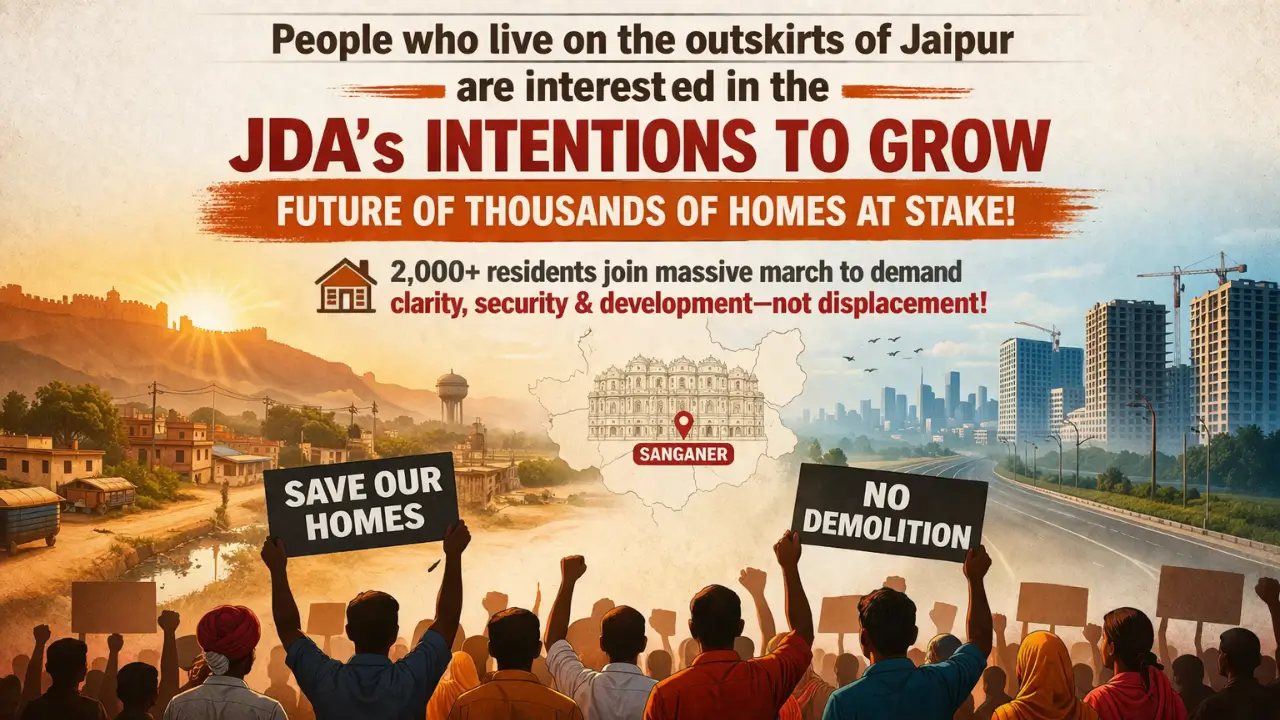
People are talking about Jaipur’s rapid urban growth again, but this time they’re not just talking about how fast it’s growing; they’re also talking about who genuinely benefits from it. People who reside on the outskirts of Jaipur are worried about the Jaipur Growth Authority’s (JDA) plan to make the city bigger. They claim that improvement on paper isn’t helping people in real life.
What is the issue?
The JDA wants the projected Master Plan 2047 to have a significantly wider effect on the world. This would include more rural and remote areas, making the total area over 6,500 square kilometers. Experts and average people worry that the extension could cause more difficulties than it solves, even though the city insists it is a step toward planned urban growth.
The Rajasthan High Court has already stopped this building project because they are worried about planning loopholes and whether the infrastructure is ready.
Things are becoming better without the essentials, to be honest.
People who live in colonies on the edges of Ajmer Road and other places see things in a different way. Even though these communities are part of the development authority’s long term plan, they nevertheless have trouble providing basic public amenities like sewage, drainage, and regular maintenance.
In some circumstances, not knowing who is in charge has made things worse. Residents are stuck in a bureaucratic gray area since the local panchayat and the JDA don’t completely handle critical services. This means that even simple tasks like cleaning the sewage could take a long time.
Experts Call It “Unplanned Growth”
Urban planners are quite worried about how huge and how fast the increase will be. They say that the plan encourages low density, spread out development, which makes it harder and more expensive to build roads, water systems, and public transportation.
The plan also plans for a population density that is much lower than what is needed. This illustrates that big rural areas are being added without the necessary urban planning tools.
Experts are worried that this kind of growth could lead to urban sprawl, which is when communities spread out without the right infrastructure, making life worse instead of better.
Push for real estate instead of what people truly need
One big problem is that it seems like the growth is more about making money off of real estate than helping people. Some individuals argue that putting a lot of land on the outskirts of the city under JDA management makes it worth more and makes it possible to start new projects. But if people can’t get the basic services they need, they could have to live in places that aren’t fully developed.
The increase is far less likely to go smoothly without the right zoning, development committees, and planning in stages.
The policy still has certain gaps in it.
The Rajasthan Township Policy 2024 isn’t fully in place yet, but it promises steady and organized expansion. Reports say that important systems like zoning rules and planning committees are still not in place. This means that there is a difference between what the government promises it will do and what it actually does.
Because of this lack of planning, it may take years for new areas included to an official urban plan to be created.
What It Means for People Who Live There
People who live on the outskirts of Jaipur are most worried about not knowing what will happen next. A bigger growth zone should mean better roads, better services, and higher property values. But if you don’t plan and do it well, it could instead lead to neglect, confusion, and poor growth.
The Big Question
Jaipur is visibly growing, and its future depends on new homes, roads, and buildings throughout the city. But the current debate makes a good point:
Is it enough to just grow, or do you require good planning, infrastructure, and accountability to develop in a meaningful way?
People who live on the edge are looking for a model of development that goes beyond maps and ideas and genuinely makes life better as the conversation goes on and the authorities look over the plan again.





/socialsamosa/media/media_files/2025/08/20/social-media-calender-2025-08-20-14-53-00.jpeg)


