
/socialsamosa/media/media_files/2025/08/20/leaderboard-new-3-2025-08-20-14-33-18.png)

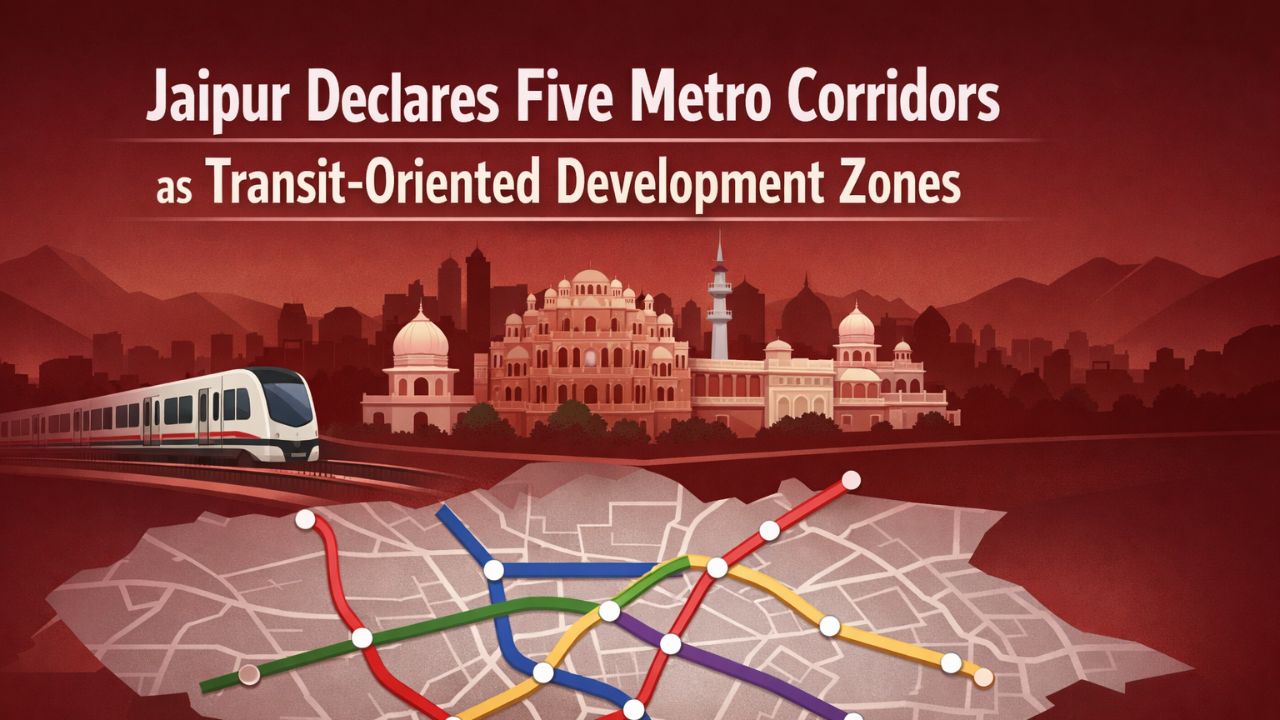
Jaipur is taking a clear step toward smarter urban planning. The Jaipur Development Authority has officially declared five major roads along the metro line as Transit-Oriented Development (TOD) corridors. This decision comes under the state government’s Transit-Oriented Development Policy 2025 and aims to reshape how the city grows around public transport.
In simple terms, the focus is now on building compact, mixed-use neighborhoods near metro stations instead of spreading the city outward. It is about making daily life easier, more connected, and less dependent on private vehicles.
What Is Transit-Oriented Development (TOD)
Transit-Oriented Development is an urban planning model that promotes high-density and mixed land use near public transport hubs. In Jaipur, TOD zones are defined as areas within an 800-meter radius of metro stations.
Within these zones, residential, commercial, and select industrial uses are mandatory. The logic is practical. When homes, offices, shops, and transit are close together, people travel less, roads stay less crowded, and cities function more smoothly.
Why Jaipur Needs TOD Now
Jaipur has expanded rapidly in recent years. While this growth has created opportunities, it has also increased traffic congestion and longer commute times. Traditional low-density development makes people rely heavily on personal vehicles, adding pressure to roads and infrastructure.
TOD offers a different path. By encouraging development around metro corridors, Jaipur can reduce traffic load, improve public transport usage, and create more walkable neighborhoods.
Role of Jaipur Development Authority
The TOD decision was taken under the policy framework approved by the Government of Rajasthan. JDA commissioner Anandhi stated that the move aligns with the state’s long-term urban mobility and sustainability goals.
The authority aims to ensure better land use efficiency, improved metro ridership, and balanced development across residential and commercial segments.
List of Declared TOD Corridors
The five metro-linked corridors notified as TOD zones are:
- Veer Tejaji Circle to Pandit TN Mishra Marg (1.4 km)
- Pandit TN Mishra Marg to Bharat Ashram Marg (1.5 km)
- Bharat Ashram Marg to Janpath Marg (1.1 km)
- Janpath Marg to ESI Road (1.6 km)
- ESI Road to Tonk Road (1.3 km)
These stretches are strategically located along the metro line and are expected to see planned, high-density development in the coming years.
Impact on Real Estate and Infrastructure
For real estate developers, TOD corridors open new opportunities. Projects near metro stations often attract higher demand due to better connectivity. Mixed-use developments with homes, offices, and retail spaces in one location can significantly improve project viability.
From an infrastructure point of view, TOD will require upgrades in water supply, sewage systems, and public amenities. Coordinated planning will be essential to support higher population density.
Benefits for Citizens and the City
For daily commuters, TOD means easier access to the metro and shorter travel times. For the city, it means reduced carbon emissions, better traffic management, and more vibrant local economies.
Local businesses also benefit as increased footfall supports shops, cafes, and service providers around metro stations.
Conclusion
Declaring five metro corridors as Transit-Oriented Development zones marks a major shift in Jaipur’s urban planning approach. Instead of expanding endlessly, the city is choosing to grow smarter by building around public transport. If implemented well, TOD can improve mobility, boost economic activity, and enhance the overall quality of urban life in Jaipur.
FAQs
1. What is a TOD corridor?
A TOD corridor is an area around public transport hubs where high-density, mixed-use development is encouraged.
2. How large is a TOD zone in Jaipur?
It covers areas within an 800-meter radius of metro stations.
3. Is mixed land use compulsory in TOD areas?
Yes, residential, commercial, and certain industrial uses are mandatory.
4. Will TOD affect property prices?
Properties near metro stations usually see higher demand and better appreciation.
5. Can more TOD corridors be added in the future?
Yes, more corridors may be notified as the metro network expands.







/socialsamosa/media/media_files/2025/08/20/social-media-calender-2025-08-20-14-53-00.jpeg)


