Techqart

JDA

New Land Registry Rule in Rajasthan Sparks Claims of Builder Bias

New Land Registry Rule in Rajasthan Sparks Claims of Builder Bias

The Urban Development and Housing (UDH) department’s newly introduced land registry rule in Rajasthan has triggered strong criticism across legal, administrative, and real estate circles. While the regulation is being positioned as a step toward planned development, many argue it quietly shifts power toward large builders and makes land transactions far more difficult for small landowners, farmers, and individual buyers. At the heart of the controversy is a new requirement that prevents the registration of sale deeds unless the land has an official conversion certificate. This certificate changes the land’s status from agricultural to residential or industrial and must be obtained from authorities such as the Jaipur Development Authority (JDA) or other government bodies. Why the Rule Is Under Fire Critics say the rule ignores ground realities. For large developers, obtaining conversion certificates is routine. They have legal teams, consultants, and financial resources to manage approvals without much disruption. For individual landowners, especially farmers, the process is anything but simple. Conversion certificates involve multiple approvals, significant fees, and long waiting periods. Many small landowners lack the time, money, or administrative experience to navigate this system. As a result, they may feel forced to approach big builders to handle land transactions on their behalf, often at unfavorable terms. A senior UDH official, speaking anonymously, noted that the rule creates indirect pressure on landowners to rely on large developers. Instead of enabling fair and open transactions, it risks centralizing control of land deals in the hands of a few major players. Impact on Farmers and Small Landowners For farmers on the outskirts of cities like Jaipur, selling small portions of agricultural land has traditionally been a way to meet financial needs. Under the new rule, even genuine buyers cannot register a purchase unless conversion is completed beforehand. Critics say this effectively blocks independent land sales. Many farmers fear their land will lose immediate market value because buyers are unwilling to take on the uncertainty of conversion. This could leave landowners with limited choices and reduced bargaining power. Problems for Buyers and Existing Plot Owners The rule also affects buyers and current plot owners. Buyers are becoming increasingly cautious, avoiding plots without conversion certificates due to fears of registration rejection and legal complications. Existing plot owners who purchased land legally in the past but did not obtain conversion are now facing resale difficulties. Lawyers working at district collectorate offices warn that this could lead to a rise in informal agreements or stalled transactions, creating more legal disputes rather than reducing them. JDA Expansion Adds to Concerns The timing of the rule has raised further questions. It coincides with the recent expansion of JDA’s jurisdiction to include several villages in the Lajpur district. These areas were already seeing increased real estate activity. The new regulation adds another layer of compliance just as demand was growing, affecting both sellers and buyers. Calls for Review and Clarity Legal experts and policy observers are not entirely against regulation. Their concern lies with how abruptly the rule was enforced and how little clarity was provided to the public. Many landowners only became aware of the requirement when they reached registration offices. Critics suggest the government could have adopted a phased approach, simplified conversion for small plots, or provided exemptions for farmers. Clear guidelines and awareness campaigns could have reduced confusion and backlash. Conclusion While the aim of planned development is valid, the current form of Rajasthan’s new land registry rule appears to place an unequal burden on small landowners while benefiting large builders. Without timely clarification or policy adjustments, the rule risks reshaping the land market in ways that reduce fairness, limit choice, and push independent players to the margins. Development works best when growth is inclusive, not when access depends on size and influence.

New Land Registry Rule in Rajasthan Sparks Claims of Builder Bias Read More »

Jaipur’s Development Authority Shifts Lease Process Online

Jaipur’s Development Authority Shifts Lease Process Online

The Jaipur Development Authority (JDA) has rolled out a major digital upgrade by moving its entire lease and lease deed issuance process online. With this transformation, citizens no longer need to visit the JDA office physically. From applying for a lease to receiving the final document, everything can now be completed digitally. This step aims to make the process faster, more transparent, and highly convenient for Jaipur’s residents. A Complete Digital Transformation According to JDA Commissioner Anandhi, this initiative ensures complete accessibility and transparency. The entire workflow—from the initial application to the issuance of the final lease document—is now fully paperless. This marks a significant shift in how government services are delivered in the city. A senior JDA official highlighted that applicants can now complete Aadhaar-based e-KYC online and even sign documents digitally. The system also supports online stamping and stamp duty payments, eliminating the need for physical stamp papers. This not only saves time but also removes the dependency on third-party agents. Key Features of the New Online Lease System 1. Aadhaar-Based e-KYC Identity verification is now smoother than ever. Applicants can authenticate their details with Aadhaar instantly, reducing delays. 2. Digital Signature Support Applicants can sign all required documents digitally, ending the need for manual signatures or physical visits. 3. Online Stamp Duty Payment The platform enables users to make all stamp duty payments online. Physical stamp papers are no longer required, even in leasehold-to-freehold conversions. 4. Fully Paperless Workflow Every step—from application submission to final lease issuance—is handled digitally, ensuring a clean, secure, and faster experience. Leasehold to Freehold Conversion Simplified One of the most impactful changes is the digitization of leasehold-to-freehold conversions. Previously, this process often required multiple visits, physical stamps, and signatures. Now, the entire procedure is online and paperless, including digital verification and authentication by JDA officials. This simplifies the process and improves efficiency for thousands of property owners. How the New Process Works The new online system is designed to be simple and user-friendly: Users create an account on the JDA portal. They fill out the online application form. Aadhaar-based e-KYC verifies identity instantly. All required documents can be uploaded digitally. Stamp duty payments are made online. The final lease or lease deed is issued digitally and can be downloaded anytime. Benefits for Citizens This shift offers multiple advantages: Convenience: No need to visit the JDA office, saving time and effort. Transparency: Applicants can track their process online with no hidden steps. Cost Savings: Eliminates travel and unnecessary expenses. Faster Processing: Digital workflows reduce delays and speed up approvals. A Step Forward for Digital Governance By eliminating paperwork and manual processes, JDA has made a strong move toward modern governance. Digital records are easier to manage, less prone to errors, and enhance overall administrative efficiency. Conclusion JDA’s transition to a completely online lease and lease deed system is a major win for citizens. With features like digital signatures, e-KYC, online stamp duty payments, and a fully paperless workflow, Jaipur is stepping confidently into a more efficient and transparent digital future.    

Jaipur’s Development Authority Shifts Lease Process Online Read More »

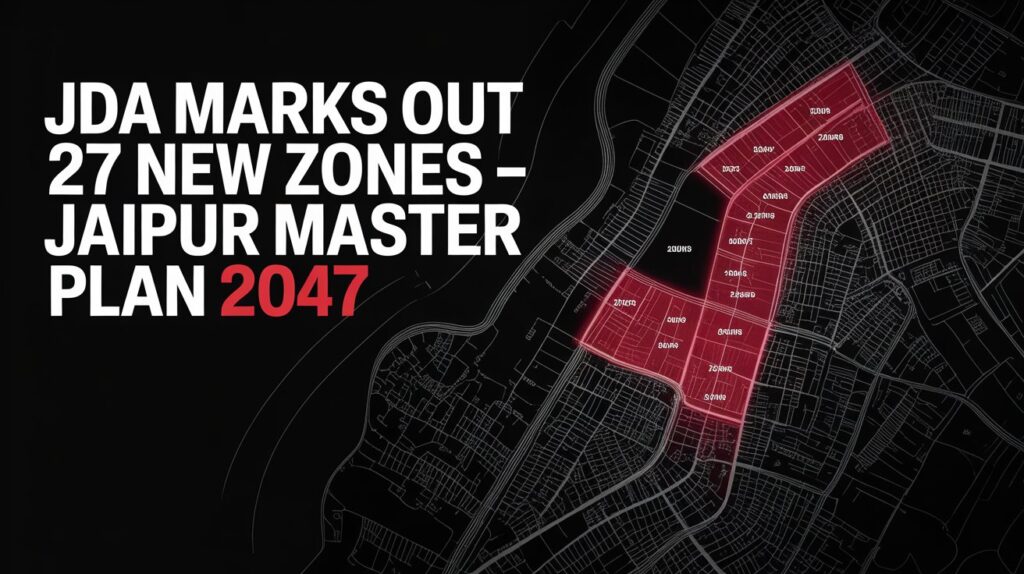
JDA Marks Out 27 New Zones in the Jaipur Master Plan 2047

JDA Marks Out 27 New Zones in the Jaipur Master Plan 2047

The Jaipur Development Authority (JDA) has taken a major step under the Jaipur Master Plan 2047, officially marking out 27 new zones to streamline development and manage the city’s rapid expansion. This restructuring aims to ensure better planning, efficient administration, and smoother urban growth as Jaipur continues to evolve into a modern metropolitan city. Why the Sudden Increase in Zones? Jaipur earlier had 18 zones, but with the city spreading rapidly toward the outskirts, the current zoning wasn’t enough to handle the growing population and development needs. To address this gap, JDA increased the number of zones by 11. However, due to merging four Prithvi (PRN) zones into two, the final count stands at 27. Officials confirmed that new maps were sanctioned and the zones were officially demarcated recently, marking a significant milestone in the city’s long-term development plan. Core City Zones Remain the Same Interestingly, the heart of Jaipur—Zones 1 to 8—remains unchanged. These areas include some of the most developed and busy parts of the city such as: C-Scheme Bypass 200-Feet Bypass ISKCON Road Jhalana Bypass These zones fall within Jaipur’s old ring road and already have a well-established urban infrastructure. Since they are structurally sound and optimally planned, no major alterations were needed. What’s New in the Updated Zones? Most changes appear in the middle and outer zones, especially where Jaipur is expanding the fastest. Zones 9, 10, and 11 – Minor Yet Important Updates Zone 9: New villages from Sanganer Tehsil have been added. Zone 10: Several Bassi Tehsil villages now fall under JDA planning. Zone 11: Small boundary adjustments were made to align with new planning requirements. These changes reflect Jaipur’s increasing urban footprint, pulling previously rural belts into the scope of planned development. Big Additions in Zones 15–25 The biggest expansion is seen in Zones 15 to 25, where most new villages included in Master Plan 2047 are located. These zones represent Jaipur’s next major growth corridors, expected to see major residential, commercial, and infrastructural development over the coming decades. Impact on Urban Development The new zoning is expected to transform how Jaipur grows. With smaller, more manageable zones, JDA will now be able to: Deliver faster administrative services Ensure balanced and organised development Improve infrastructure like roads, drainage, water supply, and public spaces Prevent unplanned and haphazard expansion For residents and investors, this change signals more clarity, smoother construction approvals, and improved future property value—especially in newly added zones. Administrative Changes by JDA With more zones comes more responsibility. Until new officers are appointed, the existing divisional commissioners handling the original 18 zones have been temporarily assigned the responsibility of all 27 zones. JDA also confirmed that soon, individual Deputy Commissioners (DCS) will be appointed for each zone to improve efficiency and resolve issues faster. Conclusion The restructuring of Jaipur into 27 zones marks a new chapter in the city’s growth story. By expanding zone boundaries, adding new villages, and improving administrative distribution, the JDA is preparing Jaipur for a more organised and sustainable future. This zoning upgrade is not just a technical change—it’s a foundation for transforming Jaipur into a smarter, better-planned, and more livable city by 2047.  

JDA Marks Out 27 New Zones in the Jaipur Master Plan 2047 Read More »